This post may contain affiliate links. Please read our disclosure policy.
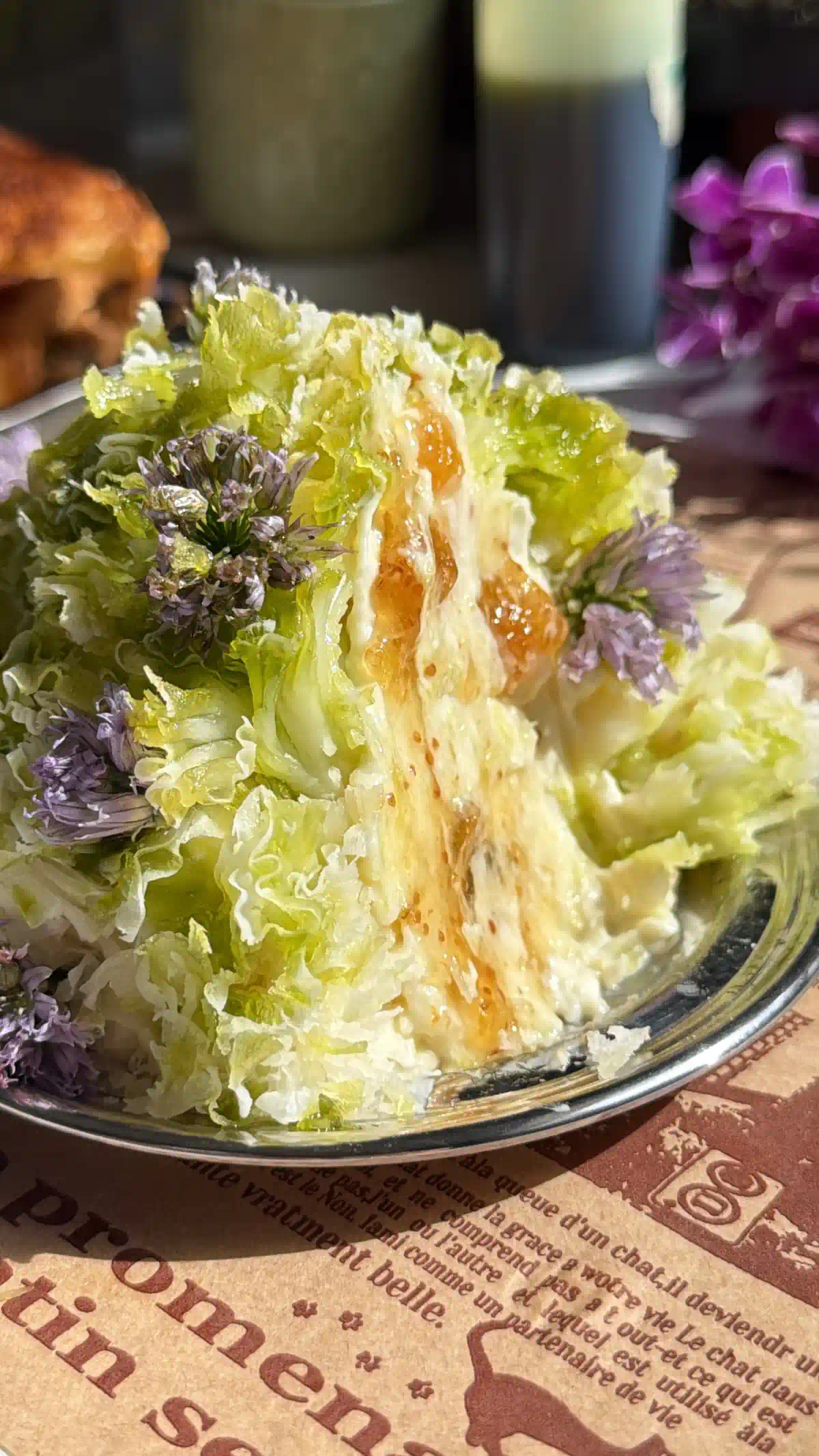
We’ve all done the salami rosettes, but have you done the cheese rosette? I love making these. It is such a cute app for Spring and summer tbh! It is incredibly beautiful – creamy, cheesy, deeply savory, sweet & herby. These delicate shaved cheese flowers sit over an airy whipped brie gently folded with fig preserves and finished with a bright basil chive oil. I served this for my Wonderland dinner party and it was a hit!
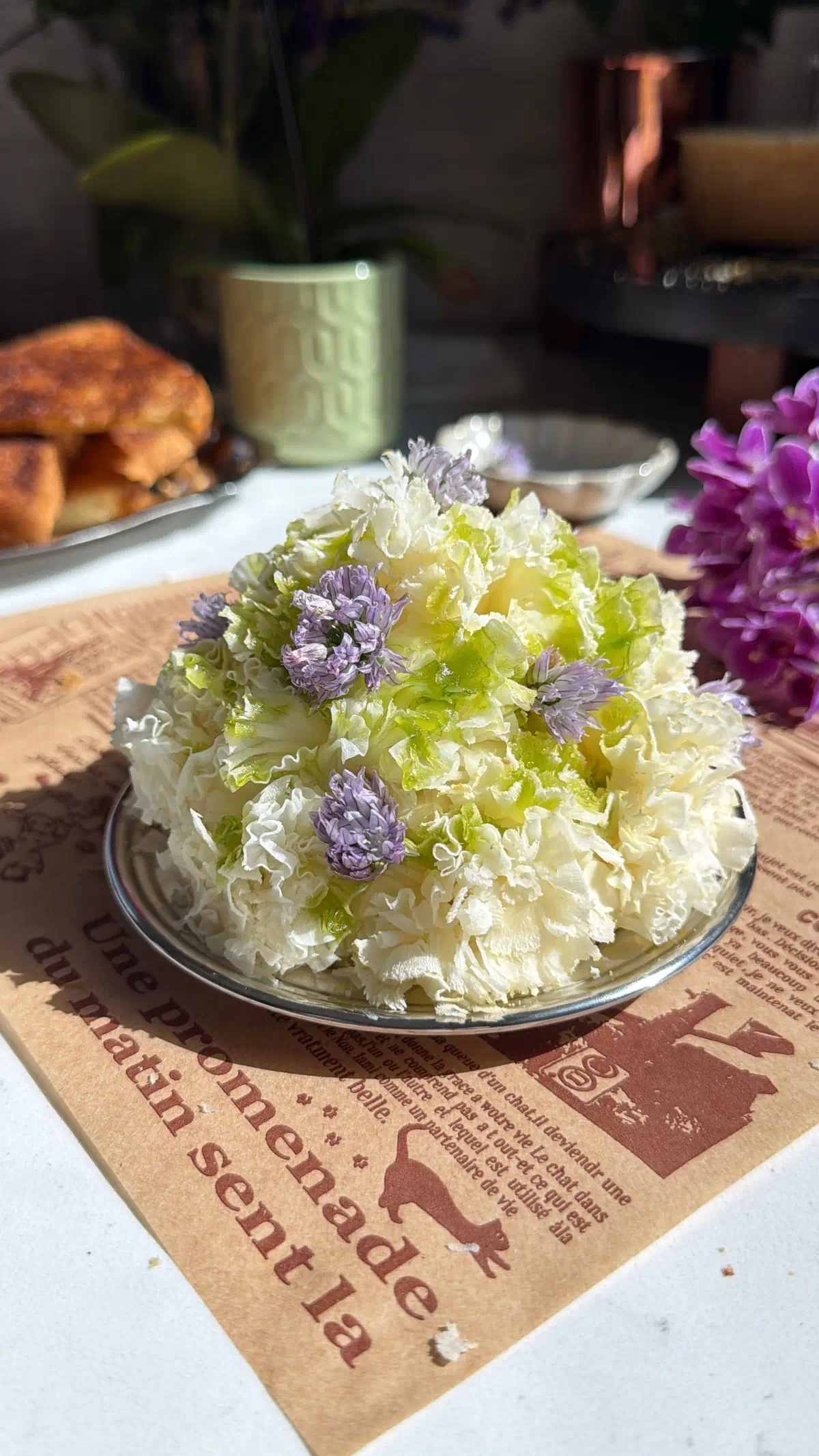
Table of Contents
Tips for Fluffy Whipped Fig Brie
Remove the Rind: Pop the wheel of brie in the freezer for 15 to 20 minutes. This will firm it up enough that it will make the cutting much easier. Leave yourself enough time to let the brie come to room temperature afterwards.
Temperature Matters: Your cream cheese and brie must be completely at room temperature. If you are in a hurry, you can always cut the cheeses into cubes to speed up the process.
Food Processor: Let the machine run long enough to whip adequate air. The textures should be an airy, swoopable cloud.
Fold, Don’t Mix: Gently fold the sweet fig preserves in by hand using a silicone spatula. Hand-folding creates the jammy streaks and gives your pockets of sweetness.
The Best Cheese Wheels for a Girolle
The girolle was originally invented in Switzerland specifically to shave Tête de Moine, a semi-hard, cylindrical cheese. Shaving it into delicate rosettes exposes is not only gorgeous, it also makes the cheese more aromatic and it melts on your tongue because of how thin it is. Once you start using this, you won’t ever want to go back!
While designed exclusively for Tête de Moine, it can be expensive and hard to find. This shaver will work with other small, semi-hard cheese wheels just the same. When selecting an alternative, there are a few things to look for. Make sure it isn’t too soft, for that paper thin cut you need it to be hard or semi-hard. The wheel needs to be the right size for your girolle. You must like the taste. Whatever you end up going with, make sure you let it come to room-temperature. This is important for the best rosettes.
Best Cheese ALTERNATIVES
P’tit Basque: A dense sheep’s milk cheese. The smooth texture and fat content allow for excellent, tight curling.
Parmesan Cheese: The texture makes this one perfect for curling. It does have a stronger flavor so make sure you’re a fan before using. This would be adorable tucked into pasta.
Pecorino Cheese: This is similar to Parmesan except a little saltier. The hard cheese that curls great.
Aged Gouda: Make sure it is a mature, firm Gouda.
Manchego: This is a firm Spanish cheese. It curls great and I love the flavor with quince paste.
Aged Cheddar: An aged cheddar works well, as it is firmer and curls easily
Tomme Brûlée: This is a great choice if you can find it. It is sweet and nutty, with hints of nutty brown butter. The shape is right and it’s hard enough to make great rosettes.
Ardi Gasna: A firm Basque sheep’s milk cheese. This is often used as an alternative and has a mild, nutty, and sharp flavor.
How to Use a Girolle
Prepare the Cheese Wheel
The Temperature Matters: Pull your cheese out of the fridge and allow it to come to room temperature. This plays a significant role in how well the girolle works.
Level the Top: Scrape the top of the rind off the top. You can also cut it in half and use only half of the wheel, keeping the exposed side up. Try to make sure the top is as flat as possible to ensure that the blade makes continuous contact.
Keep the Side Rind: Leave the side rind intact. It acts as a structural wall holding the cheese together under pressure and will naturally peel away as you shave downward.
Using the Girolle
Position the cheese: Place your cheese wheel cut-side down on a cutting board.
Insert the pole: Grab the baseplate of your girolle with both hands and flip it upside down. Center the metal pole directly over the middle of your cheese.
Drive it through: Press the wooden base down firmly and steadily, driving the pole straight through the cheese until the metal tip touches the cutting board.
Flip and secure: Flip the entire setup over so the wooden base rests flat on your counter. Press the cheese down into the baseplate to make sure it firmly catches in the four small blades at the bottom. This step is required to keep the cheese stable and prevent it from spinning while you rotate the curling blade.
Attach the top: Slide the curling blade attachment down over the center pin until it rests flat against the top of the cheese.
Shave the rosettes: Apply very light, even downward pressure and turn the handle smoothly. Let the rotation do the work to create the delicate cheese ribbons.
For more information, watch this video “How to use ?” by Tête de Moine, to see the girolle in action.
The Herb Oil
Prep the Herbs: Give the chives a rough one-inch chop.
Blanch: Bring a small pot of water to a boil. Blanch the basil and chives for 30 seconds.
Drain: Drain the herbs and squeeze them firmly to remove all excess moisture.
Blend: Place the herbs in a blender with the olive oil. Blend on high for 3 to 5 minutes until completely smooth.
Set up the Filter: Line a fine mesh strainer with a coffee filter and place it securely over a bowl. Ensure the bowl is deep enough so the bottom of the filter does not sit in the draining oil.
The Pour: Pour the blended oil directly into the coffee filter.
Wait: Let the setup sit for a few hours, stirring occasionally. Do not press or force the oil through the paper.
Storage: Once filtered, transfer the oil to a bottle or airtight jar and store it in the refrigerator.
How to Serve
Toasted Bread: Slice your favorite baguette, drizzle it with olive oil, and toast in a pan until golden. This is the classic way to scoop up that amazing creamy brie.
Artisan Crackers: Grab a thick, seeded cracker. A cracker with pecans or dried fruit baked right in will go perfectly with the savory, sweet notes in the dip.
Here are some recipes that pair great with this appetizer:



Want to save this recipe to your collection?
Frequently Asked Questions
You can make the flowers by hand. Use potato peeler to shave wide, thin strips of the chilled cheese, then gently roll them up into little spirals. They may not be as thin, but they’ll still look beautiful on top of the spread.
Yes. You can whip the cheeses and fold in the fig preserves up to two days in advance. Store the mixture in an airtight container in the fridge. Because the brie and cream cheese will firm up when chilled, let it sit at room temperature for about 30 minutes before plating so it becomes soft enough to easily shape into a dome and add the cheese rosettes.
If you cannot source P’tit Basque, a young Manchego or a smooth Gruyere are the best alternatives. You need a semi-hard cheese with enough fat to bend and curl into shape without snapping. Check out my Best Cheeses section for more info.
Store it in an airtight jar in the fridge for up to a week. The olive oil will solidify when cold, so let it sit on the counter for about 20 minutes to liquefy before drizzling it over the cheese.
Equipment
- small pot
- blender
- coffee filter
Ingredients
Herb Oil
- 1 cup basil leaves, packed
- 1/3 cup chives, chopped about an inch long
- 1 cup olive oil
- 8 oz triple creme brie
- 4 oz cream cheese, room temperature
- 3 tbsp fig preserves
- 4 oz chilled semi-hard small cheese wheel, (P'tit Basque, Gruyere or Manchego)
- 1/2 tsp chive blossoms
Instructions
- Herb Oil: Bring a small pot of water to a boil. Blanch the basil and chives for 30 seconds. Drain and squeeze the herbs firmly to remove all excess moisture. Place herbs in a blender with the olive oil. Blend on high for 3 to 5 minutes until completely smooth. Pour the oil into a coffee filter with a bowl underneath and let sit for a few hours, stirring occasionally. Do not press the oil through. Once done, transfer to a bottle and store in the refrigerator.1 cup basil leaves, 1/3 cup chives, 1 cup olive oil
- Prepare the Brie: Cut the rind off the brie while it is cold. Let brie come to room temperature.8 oz triple creme brie
- Whipped Brie: Add the room temperature cream cheese and brie to a food processor. Process until smooth. Transfer the mixture to a bowl and fold in the fig preserves, leaving visible streaks of jam rather than mixing.4 oz cream cheese, 3 tbsp fig preserves
- Assemble the Cheese Flowers: Place your p'tit wheel on girolle cheese shaver. Spin the wheel, shaving thin layers and turn them into rosettes.4 oz chilled semi-hard small cheese wheel
- Plating: Spoon the whipped brie mixture into a mound on a small serving plate. Arrange the cheese flowers, starting at the bottom and working your way up, all over the surface of the mound until covered. Drizzle with herb oil and place fresh chive blossoms around. Serve with toasted bread.1/2 tsp chive blossoms
Kitchen Cam
Nutrition
Nutrition information is automatically calculated, so should only be used as an approximation.